
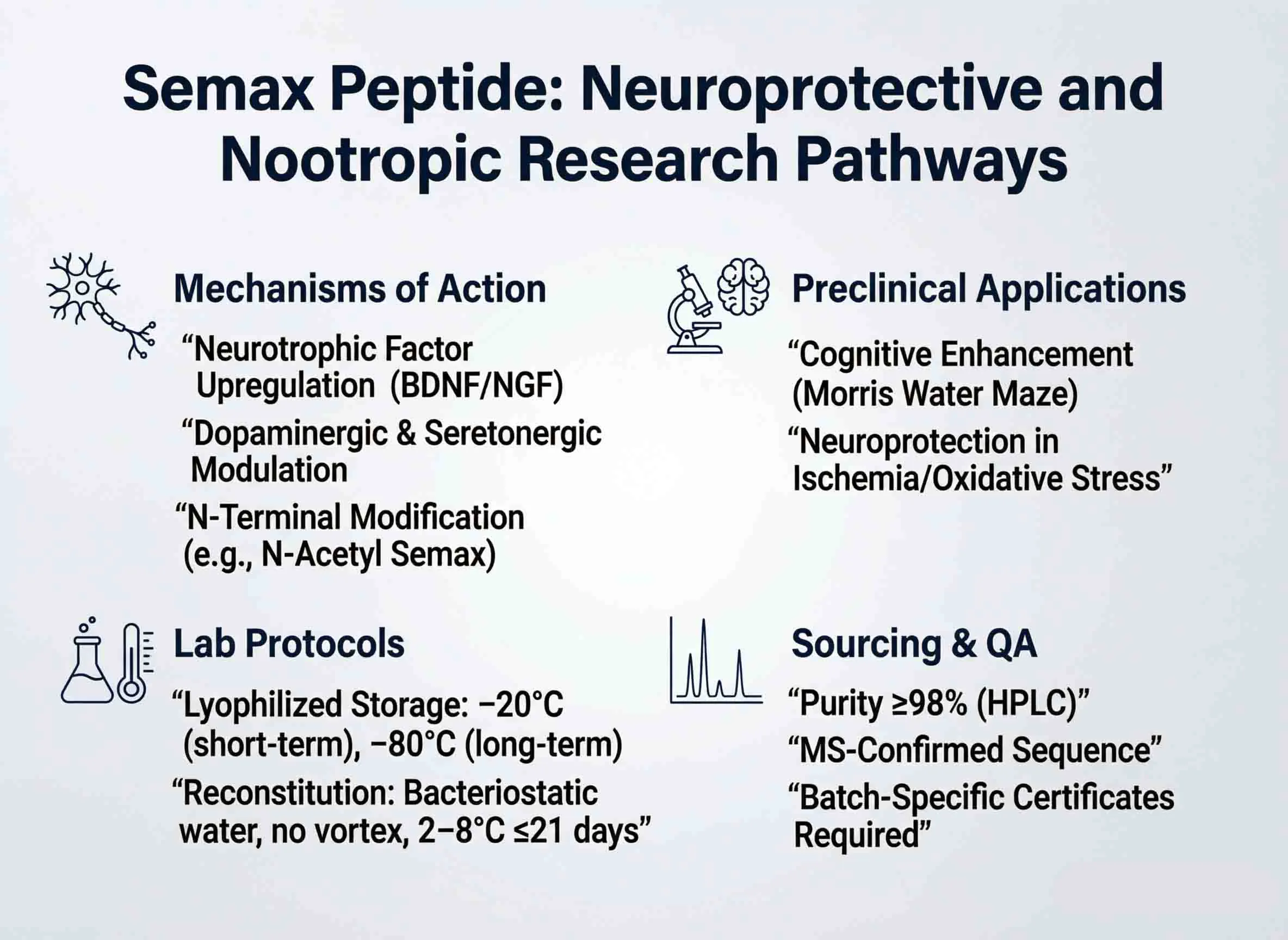
Semax Peptide: Neuroprotective and Nootropic Research Pathways
Most neuropharmacological research hits a predictable wall when attempting to isolate compounds that enhance cognitive function without inducing severe downstream tolerance or neurotoxicity. For decades, the scientific community searched for a molecule capable of modulating central nervous system (CNS) plasticity through endogenous pathways. The development of the semax peptide, a synthetic heptapeptide derived from the adrenocorticotropic hormone (ACTH) 4-10 fragment, shifted that paradigm.
Originally synthesized in Russia, this compound has become a cornerstone in neurocognitive research. Its unique ability to upregulate brain-derived neurotrophic factor (BDNF) and nerve growth factor (NGF) without the hormonal side effects of full-length ACTH makes it an invaluable subject for in-vitro and in-vivo studies. However, to leverage this molecule effectively in a controlled laboratory setting, researchers must move beyond superficial summaries and grasp the biochemical realities, strict handling protocols, and sourcing nuances of the compound.
Disclaimer: The information provided herein is strictly for laboratory research use. Semax is not intended for human or veterinary consumption, therapeutic, diagnostic, or clinical application. It is not approved by the FDA or EMA for medical use. Windy City Peptides does not provide medical advice or support for human administration.
Mechanisms of Action: The ACTH 4-10 Fragment Pathway
To understand the true pharmacological profile of this compound, we must examine its interaction at the receptor and genetic levels. The semax peptide does not operate through a single, isolated pathway. Instead, it acts as a multifaceted neuromodulator, influencing several cascades simultaneously.
Neurotrophic Factor Upregulation
The most heavily documented mechanism of this heptapeptide in preclinical models is its profound effect on neurotrophins. Research indicates that it significantly upregulates the expression of BDNF and NGF in the hippocampus and cerebral cortex. This upregulation is critical because these proteins are the primary drivers of neuronal survival, synaptic plasticity, and long-term potentiation (LTP), which are foundational requirements for effective memory consolidation and learning models.
Dopaminergic and Serotonergic Modulation
Beyond neurotrophins, the compound interacts with the monoaminergic systems. Studies demonstrate that it modulates the metabolism of dopamine and serotonin, increasing the density of dopamine D2 receptors in specific brain regions. Unlike direct dopaminergic agonists, which can lead to rapid downregulation and tolerance, this peptide appears to normalize monoamine levels, offering a more stable model for studying attention and executive function without the confounding variable of receptor desensitization.
The Role of the N-Terminal Modification
Researchers often investigate variants, including the n semax peptide (N-acetyl Semax), to study how terminal modifications affect blood-brain barrier (BBB) permeability and enzymatic resistance. The standard heptapeptide structure (Met-Glu-His-Phe-Pro-Gly-Pro) is already highly resistant to rapid degradation by peptidases compared to its parent ACTH molecule, but N-terminal acetylation is frequently studied to further extend its half-life in cerebrospinal fluid models.
Preclinical Research Applications
When reviewing the literature, the applications of this compound are consistently observed across specific, controlled laboratory models. It is critical to frame these findings strictly within the context of scientific research, as human clinical trials remain limited and regulatory approval for broad therapeutic use is absent.
Cognitive Enhancement and Memory Models
In vivo models utilizing murine subjects have repeatedly demonstrated that administration of this compound accelerates the consolidation of conditioned reflexes and improves performance in spatial memory tasks, such as the Morris water maze. Researchers utilize this compound to study the intricate pathways linking neurotrophic factor release to behavioral outputs, making it an ideal candidate for researching age-related cognitive decline models.
Neuroprotection in Ischemic and Oxidative Stress Models
For pharmacological investigators, the neuroprotective application is equally significant. Studies show that the compound mitigates neuronal damage in models of transient global cerebral ischemia. It achieves this by reducing oxidative stress markers, inhibiting apoptosis, and maintaining mitochondrial membrane potential. When researchers ask what is semax peptide used for in a neuroprotective context, the answer consistently points to its ability to preserve cellular integrity during hypoxic events.
Laboratory Protocols and Semax Peptide Dosage
The integrity of any neuropharmacological study is directly proportional to the purity and stability of its reagents. This heptapeptide is highly susceptible to degradation if mishandled. Proper laboratory technique is non-negotiable from the moment the compound arrives at your facility.
Storage of Lyophilized Semax
In its lyophilized (freeze-dried) powder form, the peptide is relatively stable but remains highly sensitive to light, heat, and moisture. Upon receipt, vials must be immediately stored in a laboratory freezer at -20°C. For long-term archival storage exceeding six months, -80°C is the industry standard. Repeated freeze-thaw cycles should be strictly avoided, as they can induce physical stress and degrade the peptide bonds.
Reconstitution Methodology
Reconstitution introduces the highest risk of peptide degradation. Adhere to the following strict protocols:
- Solvent Selection: Use high-quality bacteriostatic water (containing 0.9% benzyl alcohol) or sterile research-grade water, depending on the specific assay requirements. The benzyl alcohol acts as a preservative, inhibiting microbial growth in multi-use research vials.
- Temperature Acclimation: Allow the lyophilized vial to reach room temperature before introducing the solvent. Injecting cold solvent into a frozen vial causes thermal shock, which can fracture the peptide structure.
- Gentle Agitation: Do not vortex or shake the vial aggressively. Peptide bonds are fragile. Instead, gently roll the vial between your palms or swirl it slowly until the powder is fully dissolved. Violent agitation introduces shear stress that can compromise the molecule’s tertiary structure.
- Post-Reconstitution Storage: Once reconstituted, the solution must be refrigerated at 2°C to 8°C. Research protocols should be designed to utilize the solution within 14 to 21 days to ensure maximum pharmacological potency and prevent oxidation.
Considerations for Semax Peptide Dosage in Research
When determining semax peptide dosage for in-vivo models, researchers must rely on established preclinical literature rather than extrapolating from anecdotal human reports. In murine models, research dosages typically range from 0.1 mg/kg to 0.5 mg/kg, administered via intranasal or intraperitoneal routes, depending on the specific BBB permeability requirements of the study. Always calculate concentrations meticulously and utilize calibrated, high-precision micro-syringes to prevent dosing variance.
Sourcing and Quality Assurance
The peptide research market is saturated with compounds of dubious origin. Relying on unverified suppliers introduces unacceptable confounding variables into your data. Sourcing a reliable, high-purity Semax peptide for neurocognitive studies requires rigorous vendor qualification.
The Critical Role of HPLC and Mass Spectrometry
High-Performance Liquid Chromatography (HPLC) and Mass Spectrometry (MS) are the gold standards for peptide validation. A reputable supplier must provide batch-specific HPLC chromatograms demonstrating a purity threshold of ≥98%. Mass spectrometry is equally critical, as it confirms the exact molecular weight of the compound, ensuring the synthesized sequence matches the intended heptapeptide structure without truncation or synthesis byproducts.
Interpreting the Certificate of Analysis (COA)
Never accept a supplier’s claims without a corresponding, verifiable Certificate of Analysis. A valid COA for this research compound must include:
- Batch/Lot Number: Explicitly matching the vial received in the laboratory.
- Testing Date: Recent, ideally conducted within the last 6 to 12 months.
- Third-Party Verification: Testing performed by an independent, ISO-accredited analytical laboratory, not merely in-house quality control.
- Purity and Identity: Clear documentation of both HPLC purity percentages and MS identity confirmation.
The Semax Lab Validation Framework: Common Research Pitfalls
Even with high-purity compounds, experimental design flaws can invalidate research data. Based on extensive laboratory observation, here are the most common execution errors and how to mitigate them.
Mistake 1: Ignoring Solvent and Vehicle Controls. If your research protocol utilizes bacteriostatic water for reconstitution, the control group must receive an identical volume of the same bacteriostatic water. Failing to isolate the solvent variable can lead to false positives or misinterpreted neurological data, especially in sensitive behavioral assays.
Mistake 2: Inaccurate Dosing Due to Poor Reconstitution Math. Miscalculating the concentration (e.g., mg/mL) after adding the solvent leads to massive discrepancies in the actual administered dose in in-vivo models. A 10% math error here invalidates the entire dose-response curve. Always double-check volumetric calculations before application.
Mistake 3: Assuming In-Vitro Results Translate Directly to In-Vivo Systems. While in-vitro models are excellent for isolating receptor-binding affinities and gene expression changes, they lack the systemic variables of a living organism, such as hepatic clearance rates, blood-brain barrier permeability dynamics, and complex neuroendocrine feedback loops. Always design in-vivo studies with appropriate pharmacokinetic considerations and robust control groups.
Conclusion & Next Steps for Researchers
The semax peptide remains one of the most compelling subjects in the fields of neurobiology, cognitive research, and neuropharmacology. Its unique ability to upregulate BDNF and NGF, modulate monoaminergic systems, and protect neuronal integrity during ischemic events provides a rich, highly specific avenue for scientific exploration.
However, unlocking these insights requires an unwavering commitment to precise laboratory handling, rigorous quality control, and objective data analysis. Do not allow subpar reagents to compromise the integrity of your research. Ensure your foundational materials meet the highest analytical standards.
Ready to standardize your neurocognitive research protocols?Shop Semax Research Peptides today to review third-party HPLC/MS testing, verify batch purity, and secure research-grade materials for your next study.
Frequently Asked Questions
- What is the semax peptide?
- Semax is a synthetic heptapeptide derived from the ACTH 4-10 fragment. In laboratory research, it is studied for its ability to upregulate brain-derived neurotrophic factor (BDNF), modulate dopaminergic systems, and provide neuroprotection in preclinical models.
- What is semax peptide used for in research?
- In controlled laboratory settings, researchers use this compound to investigate cognitive enhancement, memory consolidation, and neuroprotection against ischemic or oxidative stress in murine and in-vitro models.
- How does the n semax peptide variant differ from standard Semax?
- The N-acetyl (n semax peptide) variant features an acetyl group attached to the N-terminus. Researchers study this modification to evaluate its effects on extending the peptide’s half-life, enhancing enzymatic resistance, and improving blood-brain barrier permeability.
- What are the critical handling protocols for semax peptide dosage and storage?
- Lyophilized Semax must be stored at -20°C or lower. When reconstituting, allow the vial to reach room temperature, use bacteriostatic water, gently roll (do not shake) to dissolve, and store the reconstituted solution at 2°C to 8°C for no more than 14 to 21 days.
- Why is third-party COA verification critical for this research compound?
- A Certificate of Analysis (COA) from an independent, ISO-accredited laboratory verifies that the peptide meets the ≥98% purity threshold via HPLC and confirms its molecular identity via Mass Spectrometry, preventing confounding variables caused by impurities or truncation.
By adhering to strict analytical standards and precise laboratory protocols, researchers can ensure that their investigations into the semax peptide yield reliable, reproducible, and scientifically significant data.

Be the First to Comment!
Share your thoughts and start a beneficial discussion with fellow readers.